
Trombone Slide Chart
The trombone has seven slide positions, each a semitone lower than the last. Choose a note to see its main slide position, any alternate positions and which partial of the harmonic series it uses, shown on a slide diagram. Tap play to hear the pitch, and use the full chart below to learn every note from low E2 to high F5.
- Free to use
- No sign-up
- Runs in your browser
Trombone slide position finder
Trombone Position Charts
Printable trombone slide position charts (full range with alternates), a one-page beginner chart, B♭ and F major scale sheets with positions, a partials worksheet and a practice log.
- Full chart (PDF/XLSX)
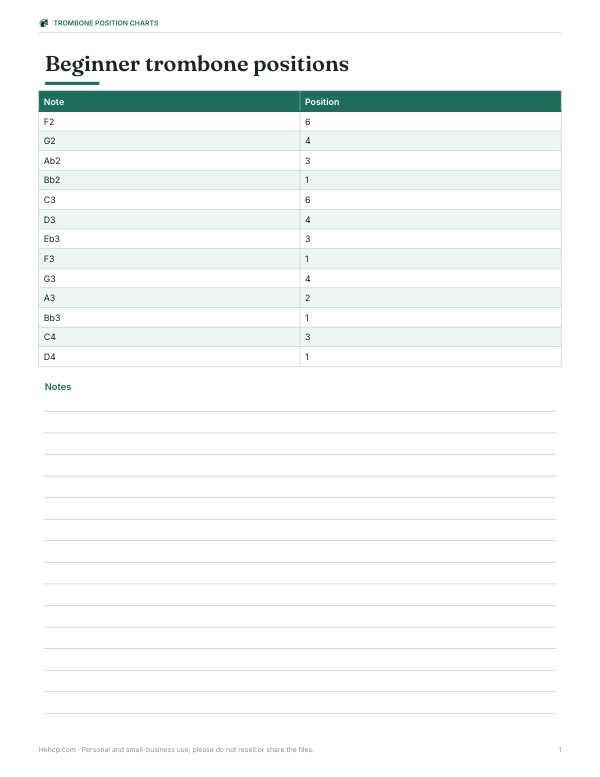
- Beginner chart (PDF)
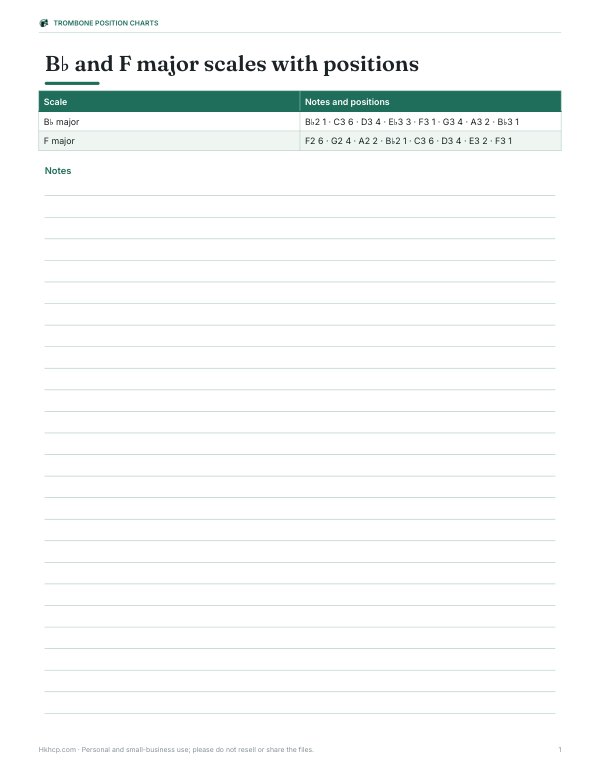
- Scale sheet (PDF)
- Positions quiz (PDF, DOCX)
- Practice log (PDF, XLSX)
Formats: PDF, XLSX, DOCX. Instant download after payment (link valid 72 hours, up to 5 downloads). AI-assisted: the templates were drafted with AI help and reviewed and laid out before publishing.
$5.00 USD, one-time 5 files · about $1.00 each
- Instant download
- 7-day refund
- Secure checkout by Stripe
7-day money-back guarantee. Full refund within 7 days of purchase, even after you download.
Free sample: Bb and F Scales (PDF, 84 KB)
Full refund within 7 days — see the refund policy and license.
Free printables
Single sheets you can print right now, no sign-up. The full pack adds every sheet in one download plus the editable files.
 Printable Trombone Positions Quiz
 Printable Trombone Practice Log
How slide positions work
A tenor trombone in B♭ plays the notes of a harmonic series — B♭, F, B♭, D, F, (A♭), B♭, C, D… — with the slide fully closed in 1st position. Each position further out lengthens the tubing enough to lower every note by a semitone, so 7th position is six semitones below 1st. By combining the seven positions with different partials (changed with the lips and air), a player can reach every chromatic note across the range.
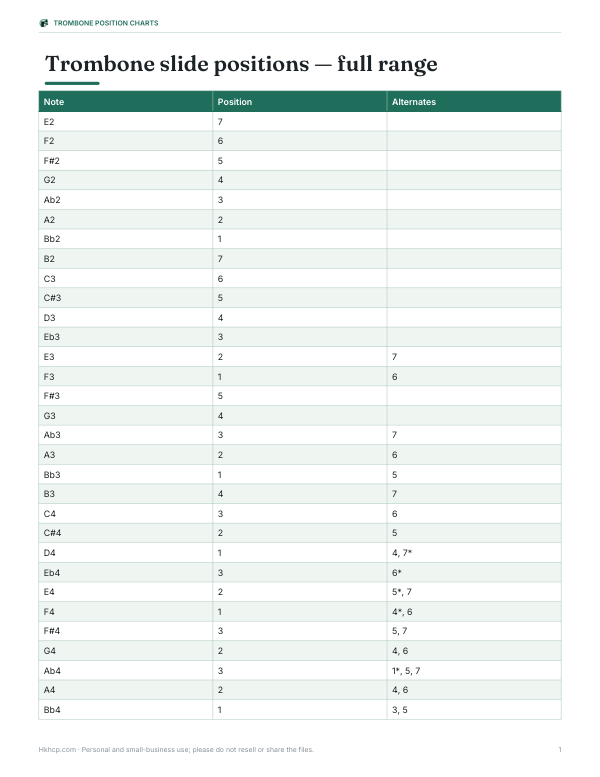
Trombone slide position chart
| Note | Main position | Alternates |
|---|---|---|
| E2 | 7 | |
| F2 | 6 | |
| F#2 | 5 | |
| G2 | 4 | |
| Ab2 | 3 | |
| A2 | 2 | |
| Bb2 | 1 | |
| B2 | 7 | |
| C3 | 6 | |
| C#3 | 5 | |
| D3 | 4 | |
| Eb3 | 3 | |
| E3 | 2 | 7 |
| F3 | 1 | 6 |
| F#3 | 5 | |
| G3 | 4 | |
| Ab3 | 3 | 7 |
| A3 | 2 | 6 |
| Bb3 | 1 | 5 |
| B3 | 4 | 7 |
| C4 | 3 | 6 |
| C#4 | 2 | 5 |
| D4 | 1 | 4, 7* |
| Eb4 | 3 | 6* |
| E4 | 2 | 5*, 7 |
| F4 | 1 | 4*, 6 |
| F#4 | 3 | 5, 7 |
| G4 | 2 | 4, 6 |
| Ab4 | 3 | 1*, 5, 7 |
| A4 | 2 | 4, 6 |
| Bb4 | 1 | 3, 5 |
| B4 | 2 | 4, 7 |
| C5 | 1 | 3, 6 |
| C#5 | 2 | 5 |
| D5 | 1 | 4 |
| Eb5 | 3 | |
| E5 | 2 | |
| F5 | 1 |
Notes are written at concert pitch in bass clef, as tenor trombone parts usually are. * marks alternates on the 7th partial, which is flat and needs a slightly shortened slide.
Where the positions are
| Position | Rough landmark on a tenor trombone |
|---|---|
| 1st | Slide fully closed |
| 2nd | About 3¼ in (8 cm) out |
| 3rd | Just before the bell |
| 4th | Level with the edge of the bell |
| 5th | Just past the bell |
| 6th | About two-thirds out |
| 7th | Almost fully extended — arm straight |
Each position is a little further from the last than the one before, because a longer tube needs more extra length for each semitone. Always tune by ear — landmarks vary between instruments.
Alternate positions
Many notes can be played in more than one position. For example, F3 is usually in 1st but can be played in 6th, and D4 is 1st or 4th. Alternates make fast passages smoother by avoiding big slide jumps — playing F3 in 6th next to C3 in 6th keeps the slide still. Tuning differs slightly between partials, so listen and adjust.
How to use the finder
- Choose a note in the list (concert pitch).
- The slide diagram highlights the main position in red and circles alternates in blue.
- Press play to hear the pitch and match it.
- Practise long tones in each position to build accuracy.
Worked example
A beginner reading a B♭ major scale plays B♭2 in 1st, C3 in 6th, D3 in 4th, E♭3 in 3rd, F3 in 1st, G3 in 4th, A3 in 2nd and B♭3 in 1st. Using F3 in 6th instead of 1st would put it right next to C3, but in a scale the 1st position is simpler. The finder shows both options for each note.
Reading trombone music
Tenor trombone parts are usually written in bass clef at concert pitch, so the note you read is the note that sounds. Higher passages may switch to tenor clef, where middle C sits on the fourth line. In British brass bands, trombone parts (except bass trombone) are traditionally written in treble clef as a B♭ transposing instrument, sounding a major ninth lower than written — so a written C sounds as B♭ below middle C, played in 1st position. The finder uses concert pitch.
The harmonic series on one position
| Partial | 1st position note | Notes | Tuning |
|---|---|---|---|
| 1 (pedal) | B♭1 | Very low, advanced | In tune |
| 2 | B♭2 | Low register | In tune |
| 3 | F3 | Low–middle | Slightly sharp |
| 4 | B♭3 | Middle | In tune |
| 5 | D4 | Middle | Flat — raise the slide slightly |
| 6 | F4 | Upper middle | Slightly sharp |
| 7 | A♭4 (flat) | Rarely used in 1st position | Very flat |
| 8 | B♭4 | High | In tune |
Knowing which partials are flat or sharp explains why good players adjust positions slightly — 5th-partial notes such as D4 are often played with the slide pulled in a little.
Practice tips
- Use a tuner or drone to check each position.
- Keep a relaxed wrist and move the slide with the forearm.
- Practise lip slurs on one position to learn the partials.
- Slide smoothly but quickly between notes, and tongue lightly to avoid glissandos.
- Learn alternate positions once main positions are secure.
Privacy
The finder runs in your browser; the tone is generated on your device.
Frequently asked questions
How many positions does a trombone have?
Seven, each a semitone lower than the previous.
What position is F on trombone?
F3 is in 1st position (or 6th); F4 is also 1st.
What position is Bb?
B♭2, B♭3 and B♭4 are all 1st position.
Why are there alternate positions?
The same note appears on different partials, so it can be reached from more than one slide position.
What does the F attachment do?
On tenor trombones with an F valve, the trigger lowers the instrument by a fourth, replacing long positions such as 6th and 7th with shorter ones.
What is the lowest note on a tenor trombone without F attachment?
E2 in 7th position, apart from pedal notes.
Which position is middle C?
C4 is usually in 3rd position (or 6th).
Why does my 4th position D sound out of tune?
Different partials have different natural tuning; adjust the slide slightly by ear.
Is the chart the same for bass trombone?
The open positions are the same, but bass trombones also use one or two valves for the low register.
Is anything uploaded?
No, it runs in your browser.